
Teachers' comments: 'The children had a great time and learnt a lot' (click for more reviews)
Preparing for the Pharaohs Workshop
Preparing for the Fashion Workshop
Permission Slip for make-up & perfume
Photos from workshops: Moss Hey (Pharaohs)
Thorp Primary (pharaohs) Dean Oaks (fashion)
Glazebury Primary (papyrus paintings)
St. Agnes CE Primary Arden Primary
Broad Oak Primary St. Catherine's Prep

Tutankhamun's gold dagger, made in the pharaohs workshop
Fee: £199 for a whole day, discounts available for small classes. Maximum 36 children per class.
To book, email Tony North: tnorth67@hotmail.com or tel: 0161 438 6634
Background information: The Gods Pharaohs Hieroglyphs Artefacts Clothing, Make-up etc.
There are two options:
1. Pharaohs (pharaohs, gods, & the afterlife),
- Learn about pharaohs like Tutankhamun (or gods) using pictures and games
- Read & write hieroglyphs, write on papyrus
- Two children dress up as Egyptians
- Look at artefacts related to pharaohs & gods
- Make artefacts related to pharaohs & gods
2. Fashion (clothes, jewellery, make up & perfume)
- Learn about Egyptian clothes, jewellery & make up using pictures and games
- Try three kinds of Egyptian perfume
- Two children dress up as Egyptians
- Look at artefacts related to jewellery & beauty
- Make artefacts related to jewellery & beauty
Curriculum links: History (gods & religious beliefs of the Egyptians, significant individuals such as Tutankhamun, tombs & the afterlife, pictures, words & communication, daily life - clothing, make-up & jewellery, learning from artefacts); art; DT; literacy (letter sounds and words)

Copy of Tutankhamun's collar, made in the workshop

Tutankamun's gold coffin, made in the workshop
The Wonders of Egypt
There is nowhere on earth like Egypt. For thousands of years tourists have been astounded by its beautiful temples and tombs, its vast pyramids and its golden treasures.
This workshop has two options. One focuses on what the ancient Egyptians cherished most - their pharaohs and their gods. Most of the amazing sights in Egypt are in some way related to these two. Pyramids were giant rock tombs designed to send the pharaoh up to heaven, and temples were sites of worship for gods, adorned with hieroglyphs proclaiming the greatness of the god and of the pharaoh who built his house.

The second option looks at another matter of great importance to the Egyptians - beauty, bodily adornment, and delicious scents. Statues and wall paintings, as well as numerous artefacts, make it clear that Egyptians - both men and women - took beauty very seriously. They used cosmetics like eyeliner, wigs which could be extremely elaborate, and many kinds of fragrance (of which children will sample three in the workshop). There was even a goddess of beauty, Hathor.

Hathor's face on a princess's mirror
The Egyptian workshop has been very popular for the last 9 years, for several reasons: the enthusiasm and depth of knowledge which I bring to the day, the in-depth tuition on the intricacies of hieroglyphs, art and other aspects of Egyptian culture, the high quality resources and creative activities which children love, and which provide a rich learning experience about ancient Egypt as well as teaching art skills, and the fantastic outcomes which you can display in the classroom.
Detailed lesson plans are provided to the right.
To book, contact:
Tony North
0161 438 6634/07754 406422
Literacy link: for an excellent retelling of Egyptian myths and stories, see Stories from Ancient Egypt by well-known Egyptologist Joyce Tyldesley.

Me (Tony North) teaching
how to read hieroglyphs

Tutankhamun's scarab pectoral, photo shown in lesson

Copy of scarab pectoral shown in the afternoon

Shabti (servant statue)
shown in artefacts session

Papyrus painting by a year 4 child

Scarab beetle painted by a year 4 child

Sistrum (rattle) made by a year 5 child,
from a wooden handle, a plastic strip,
metal wires and washers, and
plasticine to make the face of Hathor
Lesson Plan: Morning
1. Introduction to pharaohs or fashion (30-45 mins)
Pharaohs: Learn about famous pharaohs by looking at photos. We begin with Tutankhamun - his treasures, his tomb, his body, and why he is famous. Children will see the actual stones used by the Egyptians for jewellery (e.g. lapis lazuli, carnelian, turquoise). Depending on time, we also look at Khufu and the pyramids, Hatshepsut the female pharaoh, and Rameses II. In 2 teams children will answer questions and get points in a 'quiz' (e.g. what are these artefacts found in Tutankhamun's tomb, why is he famous, why were the pyramids built).

Tutankhamun's gold coffin
If you prefer we can focus on the gods (you can let me know on the day):
Gods: look at paintings of 8 gods (Anubis, Osiris, Isis, Horus, Hathor, Thoth, Ra, Amun). Learn their names, what they look like, and what they were god of: e.g. Osiris is shown wrapped up as a mummy because he was the ruler of the afterlife, and holding a crook and flail because he was god of farming.

Papyrus painting of Osiris
Play a name the god game, looking at photos on the interactive whiteboard.
Fashion: By looking at photos of paintings and statues, children will learn about Egyptian clothes, wigs, make-up, and jewellery, including bracelets, necklaces, rings, and collars. Children will handle the sorts of semi-precious stones used for jewellery (lapis lazuli, carnelian, turquoise, etc.) as well as the cloth they used for clothes and mummy wrappings (linen).

Collar in the Manchester Museum, made of faience tube beads
Children will play a game in which they try to identify items that might be found in a cosmetics kit or a bedroom, such as kohl bottles, chests for cosmetics, dishes for preparing make-up, combs, razors, and mirrors. If time allows we will also look at the various crowns and headdresses worn by pharaohs and queens.
Finally children will smell three kinds of perfume used by the Egyptians - frankincense, myrrh, and blue lotus flower - and try to guess what they are.
2. Hieroglyphs (60-90 minutes)
Children will learn about hieroglyphs by writing and reading, using a worksheet (see below) and a number of games. Depending on your preference, we will focus on hieroglyphs related to pharaohs or to gods. The hieroglyph session fits in with the fashion option too, because a lot of Egyptian jewellery features hieroglyphs (as we will see when looking at artefacts, such as Tutankhamun's scarab pectoral, which has his name on it - see left).
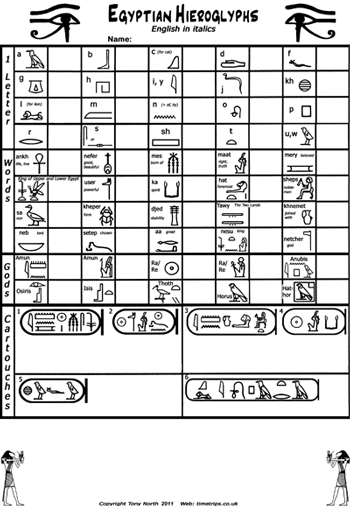
Letters - 22 letter hieroglyphs are copied. Children learn that they stand for sounds, which affects for example how they should write their own names. A game follows in which children read the name of a pharaoh spelled in letters. They will also write their own names in hieroglyphs.
Words - 20 words are copied - these include words such as god, king, and lord, as well as words which are parts of pharaohs' names (e.g. ankh in Tutankhamun). A game follows in which children translate hieroglyphs painted on a board.
Gods' names - children copy the names of the 8 gods covered earlier. A game follows in which photos of hieroglyphs (from tomb or temple walls) are shown on the whiteboard and children have to spot them.

Picture used in the god name game
Pharaohs' names - learn how to read pharaohs' names (cartouches), which are usually made up of a god's name, words, and letters. For example, Tutankhamun contains the letters T-u-t, the word ankh, and the god Amun, and it means 'the living image of Amun'. A game follows in which children try to read a pharaoh's name (e.g. Rameses).

Tutankhamun's name (written on one of his beds)
Write on papyrus - children get a piece of real papyrus paper and write any hieroglyphs they like (e.g. a pharaoh's name, god's name, their own name).

Year 4 child writing on papyrus paper
Lunch Break - Over lunch I will set out materials to make the artefacts in the afternoon. I will give you a sheet in the morning to write down which children make which artefact. I will need two children to help me set things out.
If you book a workshop I will send a letter which will let you know what resources we need (basic things like paint palettes, pots for water, table covers, painting shirts, and paper towels).

Painting an eye of Horus
Lesson Plan: Afternoon
1. Clothing (15 mins pharaohs option, 30 minutes fashion option)
One boy and one girl will be chosen to dress up as Egyptians, with linen clothes (a dress for the girl and a kilt for the boy), plaited wigs, jewellery (bracelets and necklaces, including a replica of a princess's collar with over 1,000 beads), eyeliner, and lipstick and blush for the girl. A permission slip will be provided with the letter for children to wear the make up.
Fashion option: we will spend more time looking at the various items and discussing what they are, how they were made, and their meanings. I will also show children a couple more items of jewellery (necklaces and rings)
Pharaohs option: the children can try frankincense perfume (unless they have skin allergies or a nut allergy).

My wife Catherine modelling the clothes, wig and jewellery
2. Look at artefacts (20 mins) - Pharaohs option
Children will see a variety of artefacts relating to the pharaohs option. The artefacts are copies, most of which I made myself. You can see photos of them on this page and here. This activity will teach children about the items and their meanings, and inspire them to create their own works of art.
Artefacts include statuettes (gods, pharaoh, sphinx, scarab beetle, shabti, Tut's coffin, Tut's mask), Tut's scarab pectoral, a pharaoh's bracelet (see below), papyrus paintings, Tut's dagger, and an obelisk .

Copy of bracelet belonging to the pharaoh Shoshenq
3. Make artefacts (75 minutes)
I will give a short lesson on how to paint accurately with acrylic paint (e.g. dry brush after washing it, correct mistakes, keep hand steady by resting it on the table, only touch with the tip of the brush).

Then children will make an artefact - these will be similar to those I have shown them. Each child has his or her own artefact, except when it would be very difficult for one child to finish it. Depending on the option chosen for the day, there will be up to 16 different artefacts in all - this means you can make a very impressive museum display.

The methods and materials have been carefully designed so that children can make artefacts of high quality and durability. They are also differentiated by difficulty level so you can assign a suitable task to each child. Photos of the artefacts are shown here: pharaohs fashion.
Pharaohs option: Artefacts include statuettes of Horus, Anubis, a pharaoh (see below), sphinx, scarab beetle, shabti, Tut's coffin, and Tut's mask, Tut's broad collar, Tut's scarab pectoral and falcon pectoral, a pharaoh's bracelet, papyrus paintings (printed for children to colour in), Tut's gold dagger, and an obelisk.

Pharaoh statue painted by a year 4 child
Fashion option: Artefacts include 3 types of necklace with pendants and beads (Eye of Horus, Osiris plus Ankh/Djed/Nefer hieroglyphs, and scarabs), mirror, sistrum (musical instrument), Tut's scarab bracelet (see below), Tut's broad collar, collars made with pasta, Shoshenq's Eye of Horus bracelet, Tut's scarab pectoral, and Tut's falcon pectoral.

Tutankhamun's scarab bracelet


Tut's dagger and a mirror, made by year 4 children

Anubis statue painted by a year 5 child